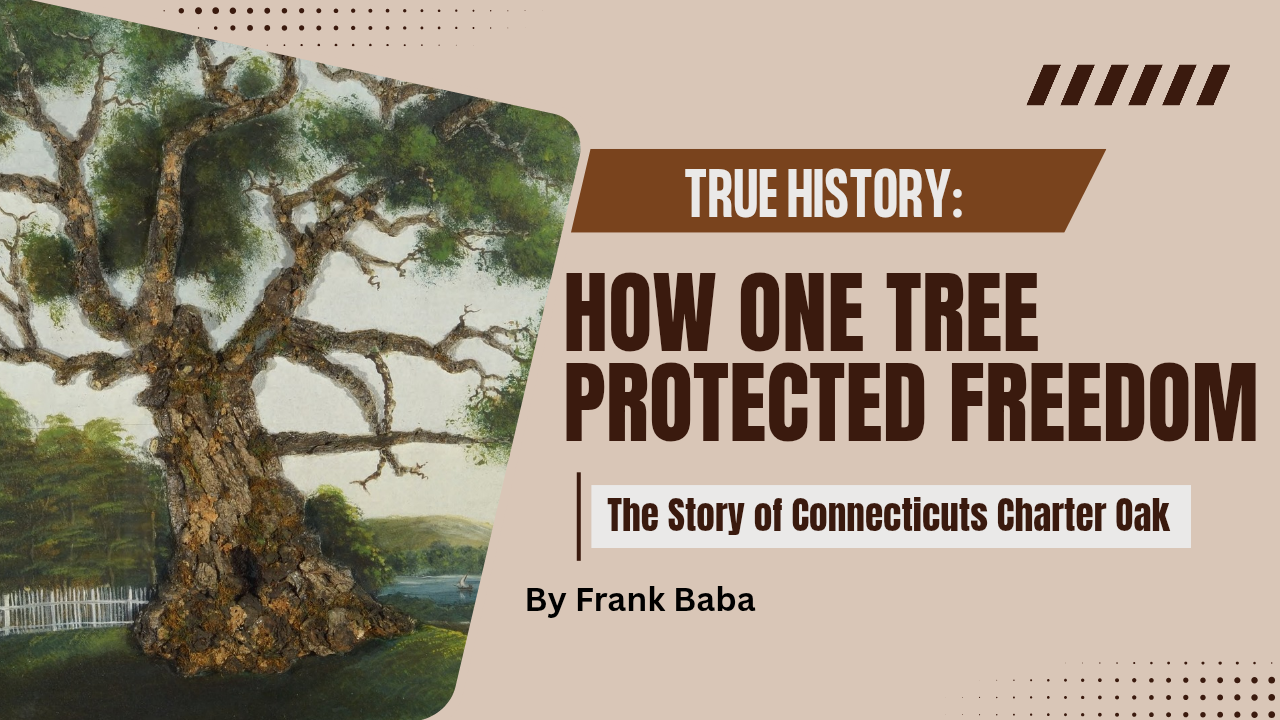
Long before the American Revolution began, a quiet act of defiance took root in the woods of Hartford. It was bold, unexpected, and it all started with a tree. Connecticut’s Charter Oak is more than just a state symbol. It was the hiding place for one of the most daring political moves in colonial history, an act that sent a powerful message to the British Crown long before muskets and minute-men made it official.
This is the story of how Connecticut once hid its own government inside a hollow oak tree to avoid surrendering power. It sounds like folklore, but it really happened. That is why the Connecticut Charter Oak still lives on not just in branches and leaves but in legend, state pride, and even your pocket change.
A Crown, a Charter, and a Clash of Wills

In 1662, King Charles the Second granted Connecticut a royal charter. This document gave the colony an unusual amount of freedom, including the right to elect its own leaders. For decades, colonists governed themselves with little interference from the British.
But the good times did not last. By 1687, Charles was gone, and his successor, King James the Second, wanted more control over the colonies. He sent Sir Edmund Andros, the royal governor of the Dominion of New England, to take that freedom back. Andros arrived in Hartford with a mission to seize the charter and erase Connecticut’s independence.
The colonists were not going to give it up without a fight.
Lights Out, Charter Gone

Legend says it happened on a cool October night. Governor Andros met with Connecticut leaders at a public house in Hartford. The room was tense. The charter lay on the table between them. Just as Andros reached to take it, the candles flickered and then went out completely.
In the confusion, someone grabbed the charter and disappeared into the night.
Who was it? Some say it was Captain Joseph Wadsworth, a man trusted by the colony’s leaders. Whatever the truth, the document was hidden in a place no royal officer would dare search. That place was inside a hollow oak tree on the estate of Samuel Wyllys.
This tree would become known as Connecticut’s Charter Oak. It was now sheltering the soul of a colony.
Connecticut’s Charter Oak Becomes a Legend

Andros never recovered the charter. Though he held power briefly, his rule collapsed when King James the Second was overthrown the next year. Connecticut’s charter remained safe, and so did its government.
As for the tree? It grew into a symbol of rebellion and resourcefulness. The story passed down through generations. The Connecticut Charter Oak became a point of pride, especially as the colonies moved toward full independence.
Even after the tree fell during a storm in 1856, it was far from forgotten. Its wood was used to craft chairs, desks, and even a ceremonial desk for the governor’s office. These relics remain reminders of a moment when liberty literally grew from the ground.
From Forest to Quarter

In 1999, the United States Mint released the Connecticut state quarter. While other states chose animals or buildings, Connecticut chose a tree. The Charter Oak was still powerful more than three hundred years later.
That decision honored not just a species of tree but a story. A reminder that freedom often starts with quiet acts of courage. Even when the lights go out, people who believe in liberty will find a way to protect it.
Why It Still Matters

Connecticut’s Charter Oak is more than an old tree. It represents the idea that everyday people can resist injustice with cleverness and resolve. No armies. No battles. Just a document, a plan, and the will to keep self-government alive.
In a time when American identity was still forming, the people of Connecticut chose to protect their charter with everything they had, even if it meant hiding it in a tree.

